
Plenty of "audits" are just an automated score with a sales pitch on top. If you're paying for one, here's what you should get back, shown on a real site: lazaruslab.net, the art shop of Remote Mend's founder. It's our own shop, not a client, and we say so on the case study.
1. Faults, not scores
A good audit names what's broken and why it matters. Ours is read-only and covers public pages only: no forms, no checkout, no login. For each finding you get the fault, the evidence, the impact and a fix. We only include a Lighthouse score when the cause is named. A number with no cause doesn't help you fix anything.
2. Evidence you can check yourself
Every finding comes with the exact URL, tag or response behind it. On lazaruslab.net, the read-only audit of 7 October 2026 found 18 issues. One example: express-payment scripts (Stripe buttons, Amazon Pay, hCaptcha) were loading on every product page, even though payment only happens at checkout.
3. A priority order
Issues are ranked by impact and rated low, medium or high effort, so you know what to tackle first. On lazaruslab.net the payment scripts came first, because they were the biggest drag on the product pages.
4. Proof after the fix
The audit is also the yardstick for the re-check. We re-audited lazaruslab.net on 11 October 2026 using the same checks:
- 13 of 18 issues resolved, 3 partial, 2 pending.
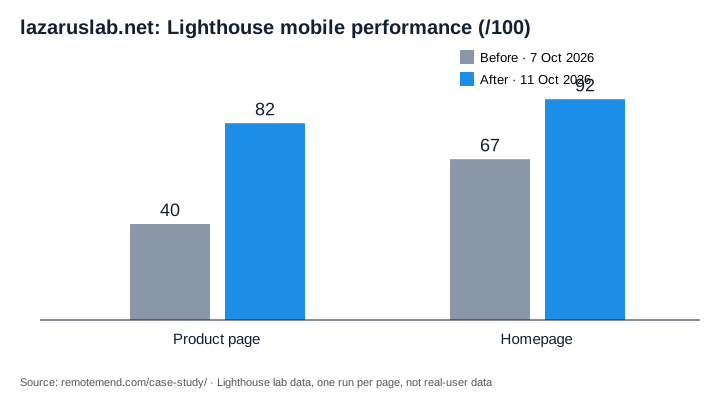
- Mobile product page Lighthouse: 40 → 82. LCP: 14.2 s → 3.7 s. Page weight: 3,522 KiB → 475 KiB, after the express-checkout scripts were limited to checkout.
- Mobile homepage: 67 → 92.
- Accessibility (Lighthouse, home / shop / product): 93 / 97 / 97 → 100 / 100 / 100. axe-core issues across 9 pages: 55 → 0.
- Third-party cookies before consent: 6 → 0. Google Analytics (GA4) after consent: blocked → working, once the security policy (CSP) was fixed.
The re-audit also confirmed fixes that never show up in a score: a public staging copy removed from DNS, a buy-button script error fixed (56 of 56 print pages work), aligned legal texts, a Spanish sitemap with 64 URLs and hreflang, the domain renewed, a CAA record added, DMARC published (p=none), and a 301 for a product URL with a typo.
5. Honesty about limits
A good audit says what it didn't check. All of these scores are lab data (Lighthouse, one run per page), not real-user field data. Lab results vary between runs, so read them as a trend. Checkout wasn't tested with a real order. Still open: a real checkout test order, a theme update and a stricter DMARC policy.
What the audit covers
SEO (titles, meta descriptions, social previews, headings, hreflang, sitemap, robots.txt, structured data), links and performance, the technology stack, content health, lead capture, and e-commerce (catalogue, pricing, stock, product URLs, policies). You get the full report as a clear document you can act on yourself or hand to your team.
Pricing
Prices are in USD and exclude tax:
- Audit: $500, credited if you approve the repair within 14 days.
- WordPress or WooCommerce repair: from $1,500, quoted in the audit.
- Website build or redesign: from $2,500.
- Square Online and site builders: from $750.
- LinkedIn company page: $250 audit, setup from $750.
Related: Why Your Square Online Site Is Slow (and How We Fixed One), a client example on another platform.
Start with the audit. Send a site → or write to info@remotemend.com.